The North Node and South Node, the head and the body, the hunger and the wisdom — the single most important axis in your chart, told through the mythology that explains why you're here at all.
Before you had a name, before you had a body, before the particular arrangement of neurons and blood and longing that you call "me" took its first breath — something chose to come here.
Not chose the way you choose a restaurant. Chose the way a diver chooses the ocean. Full commitment. Total immersion. No guarantee of return.
Something in you — call it the soul, the consciousness, the pattern that persists — looked at the infinite and said: not enough. There is something I haven't tasted. Something I haven't understood. Something I need to become that I cannot become from where I am.
And so you fell. Out of the unmanifest. Into a body. Into a time. Into a family, a culture, a specific square of earth under a specific arrangement of stars. Into limitation. Into forgetting. Into the beautiful, brutal, sacred narrowing that makes a human life possible.
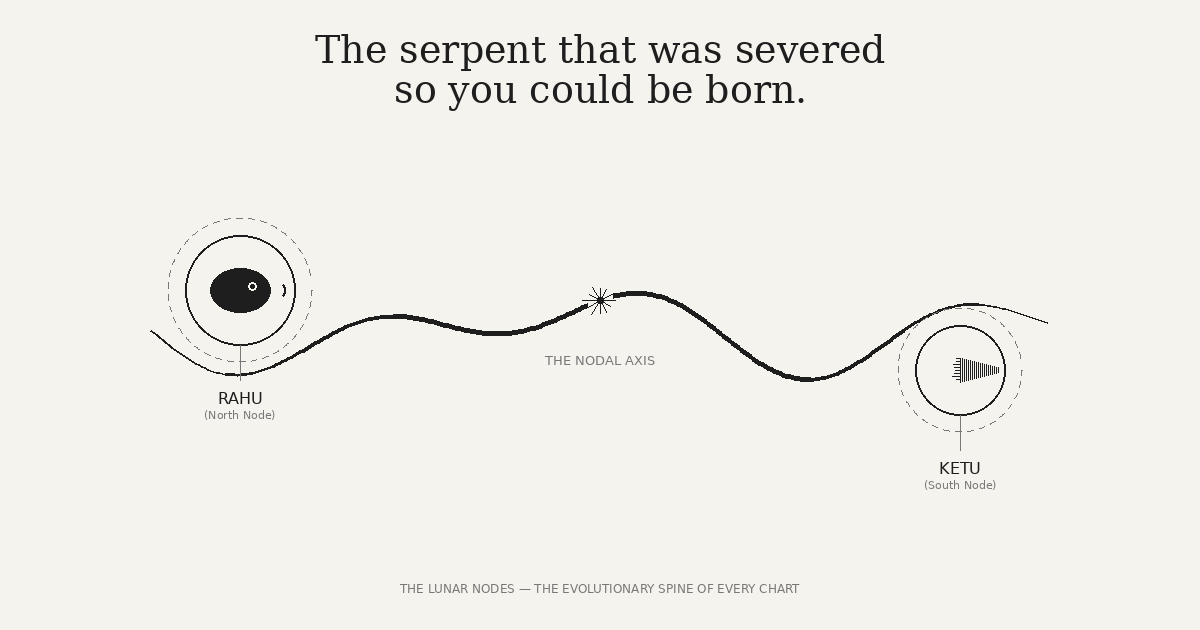
Vedic astrology has a name for the force that pulled you here: Rahu. It has a name for the force that knows how to get you back: Ketu. Western astrology calls them the North Node and the South Node.
They are the same force. One serpent. Two names. One axis that runs through your chart like a spine through a body — and every planet, every house, every sign, every nakshatra, every dasha you will ever live orbits around it.
If you understand nothing else about your chart, understand this axis. It answers the only question that ultimately matters:
What am I here to learn this time?
The Myth: When the Ocean Was Churned and the Serpent Was Split
This story is four thousand years old. It is told in the Vishnu Purana, the Bhagavata Purana, the Mahabharata, and in living temple traditions across India and Southeast Asia. It is called the Samudra Manthan — the Churning of the Ocean of Milk. And it is the origin story of everything Rahu and Ketu represent.
In the beginning — before beginning — there was an ocean of milk that contained all possibility. At its bottom lay the Amrita: the nectar of immortality. The substance that grants deathlessness. The thing every being wants.
But the Amrita would not rise on its own. It required churning. And the churning required both forces — the Devas (gods, luminous beings, forces of order) and the Asuras (demons, shadow beings, forces of chaos). Neither could churn alone. Creation requires both hands.
They wrapped the serpent Vasuki around Mount Mandara. The Devas pulled one end. The Asuras pulled the other. And they churned.
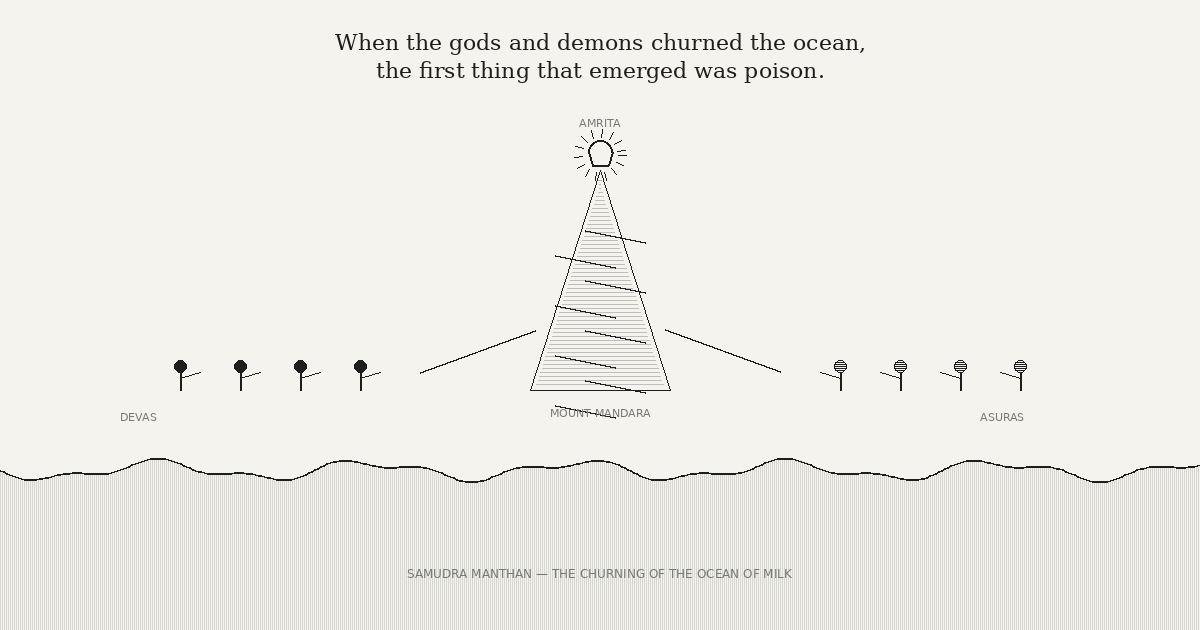
The first thing the ocean produced was poison. Halahala. A venom so total it could destroy everything. This is always the first thing that emerges when you begin the real work — the toxicity that was hiding at the bottom. The thing you'd rather not face. Shiva, the destroyer who is also the protector, drank the poison. He held it in his throat and turned blue. He did not die. He became Neelakantha — the blue-throated one. The one who metabolizes destruction without being destroyed.
Every chart has a Shiva placement. Every human carries some poison they were born to metabolize without passing it on. That placement is often Saturn. Sometimes it's Ketu. Sometimes it's a planet in the 8th house. The chart tells you which poison is yours and where Shiva sits in your system.
Then the ocean gave treasures. Lakshmi, the goddess of abundance. Kamadhenu, the wish-fulfilling cow. Airavata, the white elephant. Gifts upon gifts. This is the middle of the journey — when the work begins to produce results and life gives you things you didn't know you could receive.
Then, finally: the Amrita.
Vishnu took the form of Mohini — the most enchanting being in existence — and began distributing the nectar to the gods. The demons were to receive none. But one demon, Svarbhanu, saw through the disguise. He understood that the divine feminine was a trick. He slipped between the Sun and the Moon in the line of gods and sat down.
The nectar touched his tongue. Slid past his lips. Crossed his throat.
The Sun saw him. The Moon saw him. They cried out: Imposter. Shadow. He is not one of us.
Vishnu's Sudarshana Chakra — the discus that separates truth from illusion — flew across the hall and severed Svarbhanu's head from his body.
But the nectar had already passed the throat.
The head could not die. The body could not die. One being became two immortal shadows.
The head became Rahu. The body became Ketu.
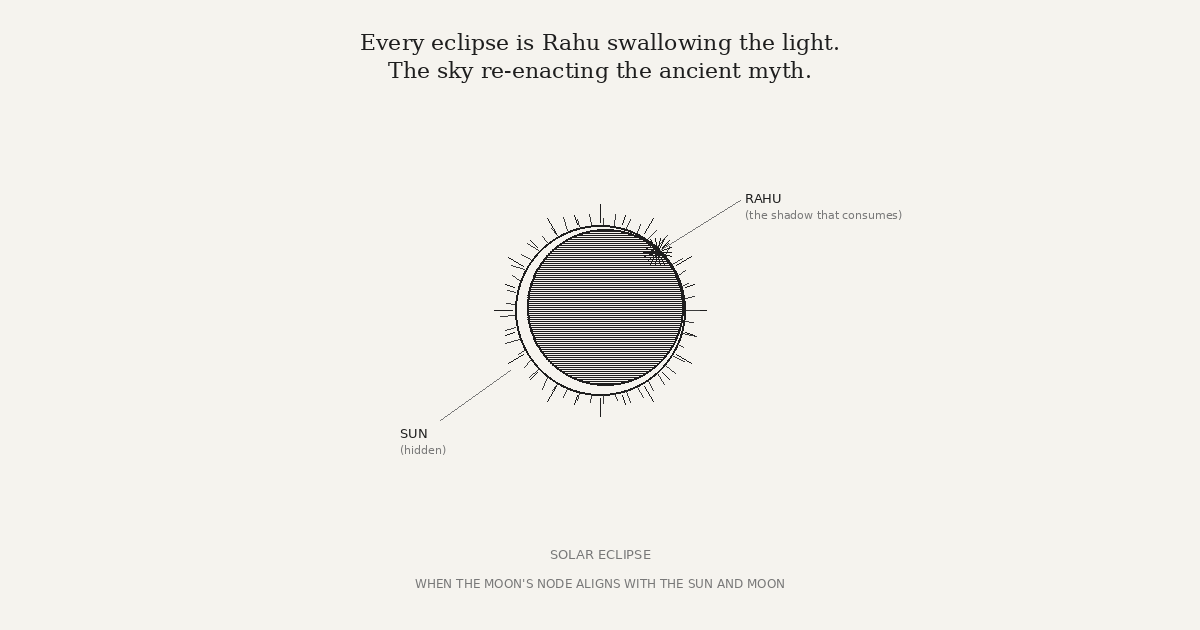
And they have been pursuing the Sun and the Moon — the two luminaries that exposed them — ever since. Every solar eclipse is Rahu swallowing the Sun. Every lunar eclipse is Rahu swallowing the Moon. The serpent that was severed has never stopped trying to become whole.
What Rahu Became: The Hunger That Drives Incarnation
Rahu is the head without a body.
He has eyes — he can see everything he wants. He has a mouth — he can consume. He has a mind — he can obsess, strategize, fantasize, and plot. But he has no stomach. No digestive system. No capacity to be nourished by what he consumes. Everything Rahu swallows falls through the severed neck into void.
This is not a punishment. This is a description of desire itself.
Rahu is the force in you that reaches for what you've never had. The career you're building with obsessive intensity. The person you can't stop thinking about. The lifestyle, the status, the experience, the identity that you believe — on some preverbal, precognitive level — will make you feel complete.
Rahu is ambition without satisfaction. Achievement without contentment. The upgrade that temporarily fills the void and then becomes the new baseline of normal, generating the next hunger, the next reaching, the next "if I can just get that, then I'll be happy."
This sounds like a curse. It is the opposite.
Without Rahu, no soul would ever incarnate. Why would consciousness — infinite, unbound, already whole — choose to compress itself into a finite body with a limited lifespan, subject to pain, loss, aging, and death? Because Rahu is hungry. Because there is something — some experience, some understanding, some flavor of being alive — that the soul has not yet metabolized.
Rahu is the reason you are here. The hunger is the mission. The reaching is the path. The dissatisfaction is not a flaw — it is the engine of evolution.
In your chart, Rahu's house and sign show the direction of your deepest growth. The unfamiliar territory. The area of life where you feel simultaneously drawn and terrified. Where you have no past-life expertise, no comfort, no inherited skill — and where the most important learning of this lifetime waits.
The Western name is the North Node. The point of destiny. The evolutionary edge. Where you're going. Modern evolutionary astrologers like Jeffrey Wolf Green and Steven Forrest describe the North Node as the soul's "growing edge" — the direction of evolution that feels uncomfortable precisely because it's new.
Same force. Same hunger. One name wears a serpent crown. The other wears a mathematical symbol. Underneath: identical.
What Ketu Became: The Wisdom That Allows Release
Ketu is the body without a head.
He can walk. He can act. He can perform with extraordinary skill. But he has no eyes — he cannot see where he's going. He has no mouth — he cannot consume or express. He has no mind — he cannot plan or strategize. He simply is. He carries the accumulated wisdom and mastery of everything that came before in his muscles, his instincts, his bones. He knows things he cannot articulate. He can do things he cannot explain.
This is not a deficit. This is the description of mastery that has become unconscious.
Ketu is the force in you that has already completed something. The skill that comes so naturally you don't value it — because it doesn't feel earned. The identity you've outgrown but cling to because it's the only one you know. The relationship pattern, the career track, the emotional strategy that keeps repeating not because it serves you but because it's familiar.
Ketu is the past. In the Vedic view, it is literally the past lives — the accumulated karma, skills, and patterns the soul carries from incarnation to incarnation. In the Western evolutionary view, it is the South Node — the comfort zone, the default mode, the path of least resistance that feels safe but stunts growth.
Ketu's gift is mastery. Ketu's trap is attachment to that mastery.
The person with Ketu in the 10th house may have been an authority figure, a leader, a builder of institutions in many previous incarnations. Career success comes easily — perhaps too easily. The soul's growth lies not in building another empire but in learning the 4th house lessons of emotional vulnerability, home, and inner peace. But letting go of what you're good at, in order to struggle at what you need to learn, requires a courage that Ketu's comfort rarely produces on its own.
This is why you need both nodes. Rahu provides the hunger that pulls you toward the new. Ketu provides the foundation of mastery that gives you something solid to stand on as you reach. The serpent that was severed is trying to become whole again. Your life is the story of the head learning to trust the body, and the body learning to follow the head.
The Western name is the South Node. The karmic inheritance. The past. What you're releasing. Astrologers like Mark Jones and Martin Schulman describe the South Node as the "default setting" of the soul — the place you retreat to under stress, the talent you over-rely on, the pattern that kept you alive in other lives but limits you in this one.
The Nodal Axis Through All Twelve Houses
The nodes are always exactly opposite each other. If Rahu is in the 1st house, Ketu is in the 7th. If Rahu is in the 5th, Ketu is in the 11th. The axis creates a polarity — two areas of life that are in constant dialogue, constantly teaching each other, constantly asking you to find balance between the hunger and the mastery.
Rahu in the 1st House / Ketu in the 7th House
The soul's thesis: Learning to be a self. Releasing the need to be completed by another.
You have spent lifetimes — or the early part of this life — defining yourself through relationships. You know how to partner, how to compromise, how to mirror another person's needs so perfectly that you disappear in the reflection. Ketu in the 7th makes you preternaturally gifted at intimacy. You can read a partner before they speak. You can merge so seamlessly that neither person knows where one ends and the other begins.
That was the mastery. Now comes the hunger.
Rahu in the 1st is calling you toward radical selfhood. The terrifying, exhilarating project of existing as a separate being who does not need another person to feel real. This does not mean abandoning relationships. It means entering them as a whole person rather than a half looking for completion.
The sidereal shift matters here. If your Rahu falls in sidereal Aries in the 1st, the call is toward Martian independence — physical, decisive, combative if necessary. If sidereal Pisces in the 1st, the call is toward spiritual selfhood — dissolving the ego through surrender rather than assertion.
Nakshatra of Rahu tells you HOW to develop the self. Rahu in Ashwini: develop selfhood through healing and rapid action. Rahu in Bharani: develop selfhood through confronting extremes. Rahu in Krittika: develop selfhood through the courage to cut away what is false.
The shadow: Becoming so focused on "finding yourself" that you destroy every relationship in the process. Independence that is actually isolation wearing a spiritual costume.
The growth edge: You can be whole alone AND choose to love. These are not opposites. The strongest relationships are between two people who don't need each other — and choose each other anyway.
Rahu in the 2nd House / Ketu in the 8th House
The soul's thesis: Building your own resources. Releasing dependence on others' power.
Ketu in the 8th gives you uncanny access to transformation, crisis, the occult, other people's money, and the hidden mechanics of power. You've navigated the underworld before — psychological depth, sexual intensity, financial entanglement, the dance of control and surrender. You know how to survive by merging your resources with others.
Rahu in the 2nd is calling you toward something that sounds mundane but is profoundly challenging for this axis: building your own value. Your own money. Your own voice. Your own stable, self-generated sense of worth that doesn't depend on anyone else's resources, validation, or emotional intensity.
The felt experience: You may oscillate between financial extremes — wealth through others (8th house Ketu mastery) and a feeling of personal inadequacy around earning, saving, and providing for yourself. Your voice may feel uncertain even when your mind is sharp. The 2nd house asks: "What are you worth when no one else is investing in you?"
The shadow: Hoarding resources out of a deep, 8th-house-flavored fear that everything can be taken away. Or alternatively, refusing to build material stability because the soul finds it "less spiritual" than the transformative depths of the 8th.
The growth edge: You are allowed to be simple. To eat well, earn well, speak clearly, and feel secure without needing the world to be in crisis. Stability is not a betrayal of depth. It is what makes depth sustainable.
Rahu in the 3rd House / Ketu in the 9th House
The soul's thesis: Learning through direct experience and communication. Releasing attachment to grand philosophies and borrowed belief.
Ketu in the 9th makes you a natural philosopher, traveler, seeker of higher truth. You may have been a teacher, a priest, an academic, a wanderer of distant lands in previous incarnations. Wisdom traditions feel familiar. Foreign cultures feel like home. The big picture comes easily.
But the soul is not here for more philosophy. It's here for the 3rd house: the local, the immediate, the specific. Conversations with neighbors, not lectures to disciples. Writing a blog post, not writing a treatise. Learning through doing, not through studying. Courage — the 3rd house is the house of parakrama, self-effort and valor in Vedic astrology — rather than faith.
The felt experience: You may struggle to communicate clearly despite having vast inner knowledge. The 9th house mastery produces someone who understands everything at a macro level but fumbles the micro — the email, the text, the daily practical exchange. Rahu in the 3rd demands you learn to be effective in the ordinary, not just brilliant in the abstract.
The shadow: Dismissing the everyday as beneath you. The spiritual pride of "I've already figured life out" while you can't hold a conversation about your own feelings.
The growth edge: The most profound wisdom is the kind that can be expressed in a single sentence to a single person who needs to hear it right now. Not from a podium. Not in a book. In a text message, at midnight, to your friend who is falling apart.
Your chart tells a deeper story
This is one placement in a constellation of many. See how your chart interacts with your Moon, Rising, nodal axis, and current dasha period.
Rahu in the 4th House / Ketu in the 10th House
The soul's thesis: Learning emotional vulnerability and inner peace. Releasing the compulsion to build external authority.
Ketu in the 10th means career mastery is almost annoyingly effortless. You know how to lead. You know how to achieve. You know how to build a reputation, manage an organization, and occupy positions of power. You've done it so many times that the corner office feels like a comfortable prison.
Rahu in the 4th is calling you home. Not to a building. To the feeling of home. The inner security. The emotional foundation. The relationship with your mother, your ancestry, your private inner world. The part of life you've been outsourcing to achievement.
The felt experience: You may reach career milestones and feel absolutely nothing. The promotion arrives and the emptiness expands. Meanwhile, the thought of being emotionally vulnerable — of needing someone, of crying in front of another person, of admitting that the successful exterior is built on an unstable interior — is more terrifying than any professional challenge you've ever faced.
The shadow: Treating home as another achievement project. Buying the house, decorating it perfectly, and still feeling homeless inside.
The growth edge: The home you're looking for is not a place. It's a feeling. And that feeling cannot be earned. It can only be received — which requires the one thing the 10th house never taught you: surrender.
Rahu in the 5th House / Ketu in the 11th House
The soul's thesis: Learning to create from your own heart. Releasing dependence on groups and collective validation.
Ketu in the 11th gives you effortless access to networks, communities, causes, and collective endeavors. You know how to organize people. You know how to contribute to something larger than yourself. Friendships may come easily but feel strangely unsatisfying — you've already perfected the social self.
Rahu in the 5th is calling you toward individual creative expression. Making art. Falling in love. Taking risks that serve no collective purpose but set your heart on fire. Having children — literally or metaphorically, creating something that is uniquely, vulnerably, unapologetically yours.
The felt experience: You may feel deeply uncomfortable in the spotlight. The 11th house mastery produced a self that excels at being part of the group, and the 5th house demands you stand apart and create from your own center. Romance may feel exposing in a way that friendship never does. Creative work may feel selfish in a way that community work never did.
The shadow: Seeking creative validation from the same groups you're supposed to be individuating from. Or refusing joy because it feels too personal, too indulgent, too separate from the collective mission.
The growth edge: Your joy is not a distraction from your purpose. It IS your purpose. The world needs your art, your love, your wild, specific, irreplaceable expression — not another committee member.
Rahu in the 6th House / Ketu in the 12th House
The soul's thesis: Learning service, discipline, and practical engagement with the world. Releasing spiritual escapism and the comfort of dissolution.
Ketu in the 12th is one of the most spiritually loaded placements in astrology. The 12th house is the house of liberation, the unconscious, foreign lands, ashrams, and the dissolution of ego. Ketu here means the soul is already deeply familiar with transcendence. Meditation may come naturally. Solitude may feel like home. The boundary between self and everything is thin — perhaps too thin.
Rahu in the 6th pulls you out of the cave and into the world. Daily work. Health routines. Service to others. Confrontation with enemies, obstacles, and the unglamorous reality of embodied existence. You're not here to float above the world. You're here to get your hands dirty in it.
The felt experience: You may resist routine with every fiber of your being. The 12th house soul wants to dissolve, to merge, to escape the hard edges of material existence. Meanwhile, your body develops health issues that demand attention. Your finances need management. People need your help in concrete, not mystical, ways. The 6th house won't let you transcend your way out of being human.
The shadow: Using spirituality to avoid responsibility. "I'm too enlightened for a day job" is the 12th house Ketu's most insidious trap.
The growth edge: True spirituality is not escape from the world. It is full engagement with the world, performed with awareness. The monk who cannot function in the marketplace has not mastered the teaching. The bodhisattva returns.
Rahu in the 7th House / Ketu in the 1st House
The soul's thesis: Learning partnership, cooperation, and the mirror of the other. Releasing the default of radical independence.
Ketu in the 1st means you arrived with a powerful, self-sufficient identity already formed. Independence is your comfort zone. You know how to be alone. You know how to act decisively without consulting anyone. You may have been a warrior, a loner, a pioneer in previous incarnations. The self is strong. Perhaps too strong.
Rahu in the 7th is calling you into the terrifying vulnerability of genuine partnership. Learning to compromise without losing yourself. Seeing yourself through another person's eyes. Allowing someone to change you.
The felt experience: You attract intense, sometimes overwhelming partners. Rahu in the 7th magnetizes relationships that are obsessive, all-consuming, and impossible to ignore. The universe keeps sending people into your life who demand that you negotiate, yield, and discover who you are in the mirror of another.
The shadow: Losing yourself in relationships as completely as you once lost yourself in independence. Rahu's hunger in the 7th can create serial partnerships, each one an attempt to find the "perfect other" who will complete the circuit.
The growth edge: The partner is not your completion. The partner is your mirror. And the mirror only works if there is a self standing in front of it. Bring the 1st house strength INTO the 7th house vulnerability. That's the integration.
Rahu in the 8th House / Ketu in the 2nd House
The soul's thesis: Diving into transformation, shared resources, and the hidden dimensions of existence. Releasing attachment to personal security and material comfort.
Ketu in the 2nd gives you a strange relationship with money, possessions, and self-worth. The material world may feel slightly unreal to you — you can earn it, but you can't quite trust it. Your voice may be quiet, understated, almost detached. You've already mastered stability. It bores you now.
Rahu in the 8th pulls you toward the underworld. Psychology, occultism, shared finances, sexual intimacy, crisis, death, and rebirth. You are magnetically drawn to what is hidden, taboo, and transformative. The mundane stability of the 2nd house is not where your growth lives. Your growth lives in the places most people are afraid to look.
The felt experience: You may repeatedly experience financial entanglements with others — inheritances, joint ventures, debts, insurance matters — that force you to merge your resources with someone else's and navigate the power dynamics that follow. Psychologically, you are drawn to depth. Surface-level conversations make you restless. You need to know what's really happening underneath.
The shadow: Becoming addicted to crisis. Manufacturing emergencies because peace feels like stagnation. Using occult or psychological knowledge as a tool for manipulation rather than healing.
The growth edge: You can visit the underworld without living there. Transform what needs transforming. Then come back up. Eat a meal. Feel the sun on your face. The depth is always available. You don't have to drown in it to prove it's real.
Rahu in the 9th House / Ketu in the 3rd House
The soul's thesis: Expanding into higher wisdom, philosophy, and the pursuit of meaning. Releasing attachment to information without vision.
Ketu in the 3rd gives you effortless communication skills, quick intelligence, and the courage to act on impulse. You're a natural writer, speaker, or networker. Short-range effectiveness is your default mode — you can handle any immediate situation. But you may feel that something is missing. A framework. A why.
Rahu in the 9th pulls you toward the big picture. Philosophy, spirituality, higher education, long-distance travel, cross-cultural experience, and the search for truth that transcends the daily. You are here to build a worldview — not just collect facts.
The felt experience: You may be drawn to foreign cultures, religions, or philosophical systems with an intensity that surprises you. The 9th house Rahu creates a hunger for meaning that the 3rd house's clever pragmatism cannot satisfy. You may find gurus, teachers, or mentors who profoundly reshape your understanding of life — and you may also encounter false teachers, because Rahu's hunger can make you gullible to anyone who offers cosmic answers.
The shadow: Becoming a perpetual seeker who never commits to a path. Collecting philosophies like souvenirs. Or becoming a true believer so rigid that the 3rd house's flexibility and humor are lost entirely.
The growth edge: The best philosophy is one you can explain simply, live daily, and question constantly. Use the 3rd house mastery to communicate the 9th house wisdom. Teach what you learn. Write what you discover. That's the integration.
Rahu in the 10th House / Ketu in the 4th House
The soul's thesis: Building a public contribution that matters. Releasing the safety of emotional withdrawal and domestic comfort.
Ketu in the 4th means home and inner peace come almost too easily. You may retreat into domestic life, emotional comfort, or the private inner world with reflexive skill. The family cocoon is warm. The interior is rich. But the soul didn't incarnate to nest.
Rahu in the 10th is calling you onto the public stage. Career. Reputation. Authority. Making a visible contribution that the world can see and be changed by. This is one of the most ambitious nodal placements — the hunger for recognition, achievement, and lasting impact is immense.
The felt experience: You may feel torn between the desire to stay home and the compulsion to build something in the world. The 4th house Ketu keeps whispering "you're safe here, you don't need to prove anything," while the 10th house Rahu is screaming "you were born to do something that MATTERS." The tension is productive. The resolution is not choosing one over the other but building a career (10th) on the foundation of your emotional truth (4th).
The shadow: Sacrificing your inner life for external achievement. Becoming a public persona with no private self. Or the reverse — using emotional needs as an excuse to never step into the arena.
The growth edge: The career that lasts is the one rooted in emotional authenticity. Build from the heart. Lead from the home. Let the 4th house depth become the 10th house authority.
Rahu in the 11th House / Ketu in the 5th House
The soul's thesis: Learning to serve the collective and build networks. Releasing the ego of individual creative brilliance.
Ketu in the 5th gives you enormous creative talent, romantic intensity, and the ability to command a stage. You know how to be special. You know how to shine. You may have been an artist, a performer, a lover, a king in previous incarnations. Individual expression is your comfort zone.
Rahu in the 11th pulls you toward something your 5th house ego may resist: the group. Communities, organizations, social causes, networks of people working toward shared goals. Your growth lies not in being the star but in being the catalyst. Not in personal glory but in collective impact.
The felt experience: You may struggle with group dynamics — the 5th house soul wants to lead, create, and be recognized as special, while the 11th house demands collaboration, compromise, and the willingness to make your individual brilliance serve something larger. Friendships may feel more meaningful than romance for this axis. Social media, audience-building, and community organizing are all 11th house Rahu territory.
The shadow: Using the group to feed the ego. Building a "community" that is actually a fan base. Or suppressing your creative gifts because the collective doesn't value individual expression.
The growth edge: The most powerful creator is the one who creates FOR something beyond themselves. Use the 5th house brilliance in service of the 11th house vision. Make art that builds community. Lead from within the group, not above it.
Rahu in the 12th House / Ketu in the 6th House
The soul's thesis: Surrendering to the invisible, the spiritual, and the dissolution of ego. Releasing the compulsion to fix, serve, and control every detail of material existence.
Ketu in the 6th gives you extraordinary capacity for work, service, health management, and problem-solving. You know how to fix things. You know how to show up daily and grind. Your competence in the material world is effortless — you can diagnose problems, manage routines, defeat obstacles, and maintain discipline without breaking a sweat. You've perfected the servant. Now the sage is calling.
Rahu in the 12th pulls you toward everything the 6th house cannot reach: the invisible world. Meditation. Dream life. Spiritual practice. Foreign lands. Isolation that is not loneliness but communion with something larger. The dissolution of the carefully maintained ego that the 6th house built through service and competence.
The felt experience: You may feel a persistent longing for something you can't name. A homesickness for a place you've never been. An attraction to monasteries, retreats, foreign countries, or any space where the rules of ordinary life soften and something more mysterious becomes available. Sleep may be unusually vivid. The unconscious may speak loudly. The material world may feel, despite your competence in it, like a costume you're wearing over a body that belongs somewhere else.
The shadow: Using spirituality as escapism. Drowning in the 12th house's boundlessness because the 6th house's discipline has been abandoned rather than transcended. Addiction, dissociation, and the loss of practical function in the name of "surrender."
The growth edge: The mystic who cannot feed themselves is not liberated. They are overwhelmed. Bring the 6th house mastery INTO the 12th house surrender. Build a spiritual practice with the same discipline you'd bring to a health routine. Structure is not the enemy of transcendence. It is the vehicle.
The Nodes and the Nakshatras: Where the Story Gets Personal
The house axis tells you the arena of the soul's curriculum. The nakshatras of Rahu and Ketu tell you the mythology — the specific deity, power, and instinctual pattern that shapes how the nodal journey unfolds.
There are twenty-seven nakshatras. Each one carries a completely different version of the Rahu-Ketu story. Here are the most powerful nakshatra-node combinations:
Rahu in Ashwini (0°-13°20' Aries): The soul's hunger is directed toward healing and speed. The Ashwini Kumaras — divine physicians who ride horses of dawn — push this Rahu to move fast, heal fast, and reach the destination before anyone else. The danger is haste without direction. The gift is the instinct to save what can be saved.
Rahu in Swati (6°40'-20° Libra): The hunger is for independence within connection. Vayu, the wind god, rules Swati. This Rahu blows through relationships, careers, and identities, never fully landing. The danger is rootlessness disguised as freedom. The gift is the ability to adapt to anything, anywhere, without losing the invisible thread that connects you to your own truth.
Rahu in Ardra (6°40'-20° Gemini): The hunger passes through storms. Rudra — Shiva in his most destructive form — rules Ardra. This Rahu grows through crisis, emotional upheaval, and the kind of suffering that strips everything down to what is real. The danger is identifying with the storm. The gift is the wisdom that comes only from having been destroyed and rebuilt.
Ketu in Mula (0°-13°20' Sagittarius): The mastery is in uprooting. Nirrti, the goddess of dissolution, rules Mula. Ketu here has already learned how to tear things down to their foundation — beliefs, identities, structures. The danger is the compulsion to keep destroying. The gift is the unshakeable root that remains after everything above ground is gone.
Ketu in Revati (16°40'-30° Pisces): The mastery is in compassion and completion. Pushan, the shepherd god, rules Revati — the last nakshatra, the final star. Ketu here carries the wisdom of endings, transitions, and the ability to guide others through the journey from one state to the next. The danger is getting lost in the dissolution. The gift is the capacity to make others feel safe during the most frightening passages of life.
Ketu in Pushya (3°20'-16°40' Cancer): The mastery is in nourishment. Brihaspati — Jupiter himself — rules Pushya. Ketu here has perfected the art of caring for others. The danger is martyrdom — giving until there is nothing left. The gift is an inner abundance so deep that it overflows naturally, without sacrifice.
Every nakshatra carries its own version of the nodal story. Your specific combination — Rahu's nakshatra and Ketu's nakshatra — creates a mythological arc that is unique to you.
The Nodes in Dasha: When the Serpent Awakens
Rahu mahadasha lasts 18 years. Ketu mahadasha lasts 7 years. Together, they account for 25 years of the 120-year dasha cycle. These are the periods when the soul's evolutionary curriculum becomes impossible to ignore.
Rahu Mahadasha (18 years): This is the period of maximum worldly expansion. Rahu's hunger activates at full power. Career ambition intensifies. Material desires amplify. The areas of life represented by Rahu's house placement become the dominant themes. This can be a period of extraordinary achievement — Rahu gives worldly results that Jupiter cannot match — but it can also be a period of obsession, compulsion, and the feeling that no amount of success is enough.
The key to Rahu dasha is conscious engagement with the hunger. The hunger itself is not the problem. It's the unconscious relationship to the hunger — the belief that satisfying it will bring peace — that creates suffering. Recognize what you're reaching for. Reach for it anyway. But don't expect it to complete you.
Ketu Mahadasha (7 years): This is the period of stripping away. Ketu dissolves whatever is no longer aligned with the soul's evolution. Jobs end. Relationships fall apart. Identities that felt permanent reveal themselves as temporary. The material world may feel increasingly unreal — not in a psychotic sense, but in a mystical one. Things you cared about stop mattering. Things you never noticed start glowing with significance.
Ketu dasha is the spiritual accelerator. It is often the period when people begin meditation, encounter spiritual teachers, have mystical experiences, or simply lose interest in the game they've been playing and start asking what lies beneath it. The danger is depression — Ketu's detachment can feel like emptiness if there's no spiritual framework to hold it. The gift is liberation from attachments you didn't know were imprisoning you.
Rahu-Ketu or Ketu-Rahu Bhukti: When one node is running as mahadasha and the other activates as bhukti (sub-period), the full nodal axis ignites simultaneously. These are often the most transformative 12-18 months of a person's life. Eclipse-like events in the personal sphere. The death of an old identity and the birth of a new one. The serpent trying, with maximum intensity, to become whole.
The Nodes and Eclipses: When the Sky Remembers the Myth
Solar and lunar eclipses occur when the Sun or Moon passes through the nodes — literally conjuncting Rahu or Ketu in the sky. This happens roughly four to six times per year.
Eclipses are not random cosmic events. They are the sky re-enacting the Samudra Manthan. Rahu swallows the luminary. The light temporarily goes dark. Whatever in your life was sustained by that light — an identity (Sun) or an emotional pattern (Moon) — is interrupted.
When an eclipse falls on a sensitive point in your natal chart — conjunct a natal planet, on your Ascendant, on your natal nodal axis — the interruption is personal. Something you thought was permanent shifts. A door closes that you didn't expect. A door opens that you didn't know existed.
Eclipses within 3° of your natal Sun: identity crisis or transformation. Eclipses within 3° of your natal Moon: emotional upheaval or breakthrough. Eclipses on your natal Rahu-Ketu axis: the deepest possible activation of your soul's evolutionary curriculum. Major life changes. New chapters beginning. Old chapters ending.
The Two Skies report includes your natal nodal axis and identifies which upcoming eclipses fall near sensitive points in your chart — so you know which eclipses are personally significant and which are just sky weather.
The One Truth About Your Nodes
You are not here by accident.
The hunger that pulled you into this body — the specific, directional, relentless hunger represented by Rahu — is not a flaw. It is your mission. The territory it points toward is the territory where your most important growth lives. It will be uncomfortable. It will be unfamiliar. You will not be naturally good at it. That is exactly the point.
And the wisdom you carry from before — the effortless mastery represented by Ketu — is not wasted. It is your foundation. The ground you stand on while you reach. The gift you give the world while you learn. The skill that allows you to survive the discomfort of the journey because you have something that works, even when everything else feels like it's falling apart.
The serpent wants to be whole.
Your chart is the map of how that happens. The nodal axis is the spine. Every planet orbits it. Every dasha activates different parts of it. Every transit triggers different phases of it. And the two zodiacs — the tropical psychology and the sidereal karma — reveal different layers of what the wholeness looks like.
Neither sky alone can see the complete serpent.
Both together reveal the creature that was always trying to reassemble itself inside you.
Your nodal axis — Rahu and Ketu's house, sign, and nakshatra — is the foundation of your entire Two Skies reading. It tells you why you're here, what you're releasing, and what you're becoming. Want to see yours?
[Get Your Free Two Skies Mini Reading →]
See your nodal axis in both zodiacs. Discover your Rahu nakshatra deity. Begin the story your chart has been trying to tell you.
[The Full 30-Page Report with 10-Year Dasha Timeline — $33 →]
Every planet interpreted in relationship to your nodal path. Your current dasha chapter and what it's activating. The complete story of the serpent that is becoming whole inside you.
One placement is one note. Your full chart is the symphony.
Discover the complete story both skies are telling about you — your psychological blueprint AND your karmic timeline, woven into a 42-page personalized report with your 10-year dasha timeline, month-by-month forecasts, and Vedic remedies.
Human astrologers charge $150–$300 for less. Your 42-page report is $33.